Resources
Stop thinking in straight Lines: why your sales funnel needs a unified strategy
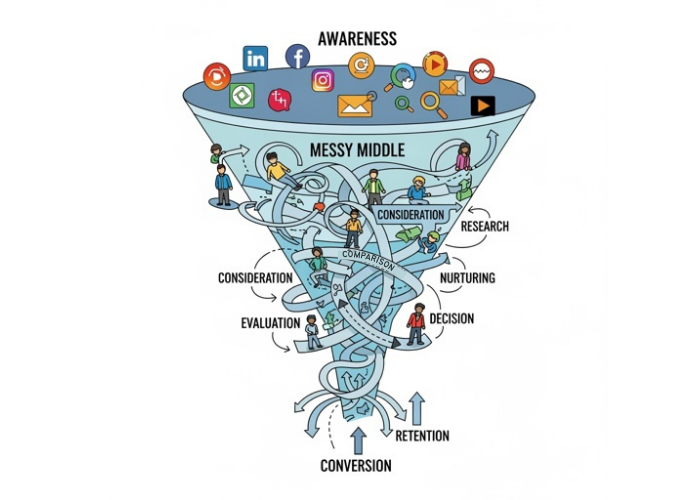
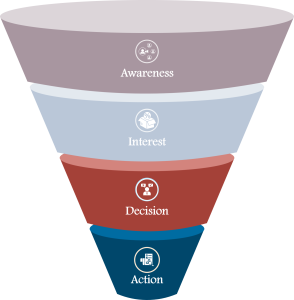
Most businesses draw their sales funnel as a tidy triangle — awareness at the top, a purchase at the bottom, and a smooth, predictable slide in between. It’s a comforting picture. It’s also wrong.
Real buyers don’t travel in straight lines. They circle back. They go cold, then re-engage months later after reading a LinkedIn post. They come in through a referral already half-convinced, bypassing stages you assumed were mandatory. They interact with your marketing team on Tuesday and your sales team on Thursday — and if those two teams are singing from different hymn sheets, the deal quietly dies.
The businesses winning the most customers today aren’t the ones with the flashiest campaigns or the most aggressive sales reps. They’re the ones that have stopped treating marketing and sales as separate departments with separate goals, and started thinking about revenue as a shared, continuous system.
The funnel is not the problem — silos are!
The funnel itself remains a useful mental model. It helps businesses think about where a prospect is in their decision-making journey and what they need at each stage. The problem isn’t the funnel — it’s the ownership gap sitting right in the middle of it.
Marketing tends to own the top: brand awareness, content, lead generation, paid media, SEO. Sales tends to own the bottom: demos, proposals, negotiations, closes. But what about everything in between? The nurture sequences, the re-engagement of stalled leads, the handoff moment where a marketing-qualified lead becomes a sales conversation? That middle ground is often ungoverned, and it’s where enormous revenue potential quietly leaks away.
Consider the numbers. Research from Forrester found that companies where sales and marketing are tightly aligned achieve 36% higher customer retention rates and 38% higher sales win rates. A LinkedIn study found that 87% of sales and marketing leaders say collaboration between the two teams enables critical business growth. Yet despite this, only around a quarter of organisations report strong alignment between their commercial functions.
Understanding the non-linear journey
Let’s talk about what the funnel actually looks like in practice, without pretending it’s linear.
Awareness doesn’t happen once. A prospect might encounter your brand through a Google search, forget about you, then see a case study shared on social media three months later. That second touchpoint reactivates awareness — and it’s often this repeated exposure that tips someone into genuine interest. This is why consistent content, thought leadership, and brand presence aren’t “nice to haves.” They’re the compound interest of your marketing activity that leads to success.
Consideration is messier than most sales pipelines suggest. A lead flagged as warm by marketing may have already had three conversations with a competitor. A cold contact in your CRM may have just been promoted and is now actively in-market. The consideration stage is fluid and context-dependent, which means both marketing and sales need real-time visibility into what’s happening — shared dashboards, shared data, shared language around lead quality.
Decision rarely happens in isolation. Buyers talk to colleagues, read reviews, benchmark your pricing, and look for social proof. This is where marketing’s output — testimonials, case studies, ROI calculators, webinars — directly enables sales conversion. When a salesperson can send a perfectly timed case study that mirrors the prospect’s exact industry challenge, the probability of closing increases dramatically.
Retention and advocacy are often cut from funnel conversations entirely, which is a costly mistake. Winning a customer is only the beginning. A customer who becomes an advocate generates referrals that enter your funnel pre-qualified and already trusting you. The flywheel only spins if marketing and sales (and often customer success) are coordinating post-sale.
Practical tips for building sales and marketing alignment
- Create a shared definition of a qualified lead. One of the most common sources of friction between sales and marketing is disagreement over what constitutes a “good” lead. Sit both teams down, define the criteria together, and build it into your CRM. When marketing knows exactly what sales needs, lead quality improves.
- Build feedback loops, not just handoffs. The lead handoff from marketing to sales should never be a one-way door. Sales needs a structured way to feed intelligence back — what objections came up, what content resonated, what the prospect actually cared about. This makes the next round of marketing sharper.
- Align around pipeline metrics, not vanity metrics. Marketing teams often celebrate impressions and click-through rates; sales teams celebrate deals closed. Neither tells the full story. Build shared reporting around metrics that connect both: cost per opportunity, lead-to-close conversion rate, average sales cycle by channel. When both teams own the same numbers, they start to operate as one.
- Map content to sales conversations. Every piece of marketing content should serve a stage of the sales process. Blog posts build awareness; comparison guides support consideration; detailed case studies close. When marketing knows the specific questions sales hears on calls, they can produce content that genuinely accelerates deals.
Where high-growth businesses excel
The data on this is increasingly hard to ignore. According to HubSpot’s State of Marketing Report, companies with aligned sales and marketing teams generate 208% more revenue from marketing efforts than those without alignment. SiriusDecisions found that B2B organisations with tightly aligned commercial teams achieve 24% faster three-year revenue growth and 27% faster three-year profit growth.
These aren’t marginal gains. They represent the compounding effect of every team member pulling in the same direction — from the first brand touchpoint to the contract signature to the renewal conversation.
High-performing businesses also invest in revenue operations (RevOps) thinking: the practice of treating marketing, sales, and business development not as separate cost centres, but as an interconnected revenue system with shared technology, shared processes, and shared accountability. It’s not about removing the distinctions between roles — it’s about removing the friction between them.
The case for a Fractional CMO
For many growth-stage businesses, the missing piece isn’t effort — it’s strategic leadership. The teams are there. The ambition is there. What’s lacking is someone with the experience to see the whole picture, diagnose where revenue is leaking, and build the systems that make alignment real.
This is exactly where a Fractional Chief Marketing Officer delivers disproportionate value.
A Fractional CMO brings senior-level commercial thinking — typically the kind built across multiple industries and growth contexts — without the full-time executive overhead. They don’t just run campaigns. They sit at the intersection of marketing, sales, and business development, working to ensure that every function is pointed at the same goal: winning more customers.
Critically, a skilled Fractional CMO has usually lived the misalignment problem themselves and knows how to fix it. They can redefine the lead qualification process, restructure how content supports the sales cycle, build dashboards that give both teams real visibility, and create the culture of commercial collaboration that most organisations aspire to but rarely achieve.
For businesses that want to accelerate — that don’t have two years to figure this out through trial and error — the Fractional CMO model offers something valuable: compressed time to impact. They’ve solved these problems before, in different sectors, at different scales, and they bring that pattern recognition directly to your funnel.
The funnel is team sport
The businesses that win consistently aren’t the ones with the biggest marketing budgets or the most aggressive sales targets. They’re the ones where every person involved in revenue generation understands their role in a connected system — where marketing builds the conditions for sales conversations to succeed, where sales informs the intelligence that makes marketing smarter, and where both teams are accountable to the same commercial outcomes.
Stop drawing your funnel as a triangle with departments at each layer. Draw it as a loop — one that marketing, sales, and business development all move around together, picking up momentum as they go.
That’s how you win more customers. Not once, but consistently.
Related posts

Sugar or Salt, can you tell the difference?

Don’t let jargon and poor language prevent your next sale